
Build a Treutlen County Property Records Search
Begin at the office that matches the question. qPublic carries the parcel and assessment side. GSCCCA runs the statewide real-estate index for recorded deeds, liens, releases, and plats. The Tax Commissioner site covers bills and payments. Soperton City Hall keeps city permits and other municipal material. County property and recorded instruments stay with county custodians.
These sources cross-reference rather than duplicate each other. Copy the parcel identifier and legal description from the tax card. Carry party names and dates into the deed index. Then compare the same parcel on the tax portal. A public lookup is not a title search or field survey.
Search with names as the records present them. The GSCCCA form expects an individual name in last-name, first-name order. Test surname and given-name variants. For a trust, estate, or company, keep the entity wording exact. Use it as the assessor roll and deed spell it. Rural land often matches by acreage, road name, adjoining owner, or subdivision lot and block. An older book-and-page reference works too. A modern postal address may be the weakest key. Save the lookup date with each result. The assessor publishes the most current digest it has. A newer transfer may already sit in the clerk's recording system.
- Search qPublic by address, owner, parcel, or legal information and record the lookup date.
- Use the GSCCCA grantor-grantee index to locate the transfer and related instruments.
- Check the assessor's values and exemptions, then use the Tax Commissioner route for the bill.
- Read the parcel map and recorded plat as reference sources, not a survey.
- Request an existing record or certified copy from its custodian when the web record is incomplete.
The Offices Behind Treutlen County Property Records
Three county offices answer the central land questions. The clerk preserves recorded deeds, the assessor maintains parcel and valuation records, and the Tax Commissioner collects the levy. Calling the right office saves time.
Clerk of Superior Court
639 Second St South, Suite 301
Soperton, GA 30457
912-529-4215
Start Treutlen Searches With Three Keys
An address is the simplest route to one site. But older rural wording, road changes, and a Soperton mailing label can hide the match. An owner name can reveal several parcels at once. Initials, spouses, estates, trusts, and entities each demand a separate search. The parcel number is exact inside the tax system. Its Treutlen format should be confirmed with the office rather than guessed.
| Starting key | Best source | Check before accepting |
|---|---|---|
| Street address | qPublic parcel search | Situs, mailing city, road wording, city line |
| Owner name | qPublic and GSCCCA | Role, dates, initials, estate or entity name |
| Parcel number | Assessor, tax, map | Exact punctuation and current parcel status |
| Legal description | Deed and plat records | Acreage, lot/block, calls, prior references |
The official Treutlen qPublic page does not always load for every visitor. When it stalls, skip the guesswork. Go to the assessor landing page instead. Ask the office directly for the existing card or map.
The request can be specific. Ask the Tax Assessor for the current property record card, value history, exemption status, and any existing parcel or map export. Include the street address and parcel number when known. The office lists public hours from 8:30 a.m. to 4 p.m. on weekdays and a phone number of 912-529-4343. Ask for records the county already keeps. The Georgia Open Records Act does not require an office to create a new ownership report or compile a custom analysis.
Soperton Is Treutlen's Only Incorporated City
Soperton serves as the county seat. It is also the only incorporated city on the official roster. City Hall handles Soperton permits, municipal court matters, police reports, and other city administrative records. Parcel, assessment, tax, and deed records stay county-held.
A Soperton mailing address proves little by itself. It does not confirm that land sits inside city limits. Compare the assessor situs, the parcel map, and the deed description. Also check the city boundary before drawing conclusions. The 2007 annexation brought the county industrial park and adjacent developed land into Soperton. An older county designation may coexist with a newer city jurisdiction.
Treutlen Deed Coverage Carries a Date Quirk
The GSCCCA landing page describes real-estate indexes from January 1, 1999. The live name and book/page forms display a banner beginning January 1, 1990. Neither notice settles Treutlen's dates. Coverage quirks like this one trip up early searches. Confirm the good-from and good-thru entries with the clerk. Use the GSCCCA real-estate portal as the official index route before calling any early search complete.
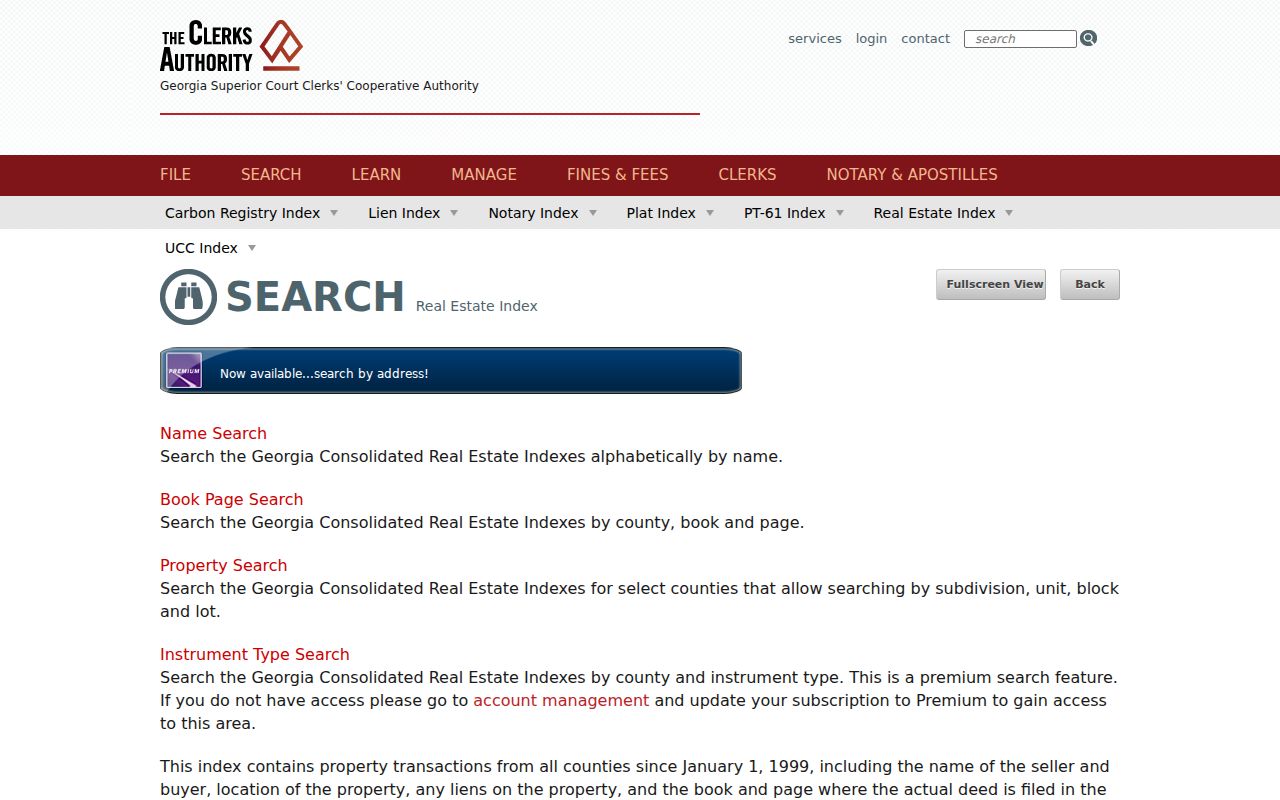
If reconstructed index text conflicts, the clerk's original record controls.
Which Treutlen County Property Record Answers Which Question
No single file tells the full property story. Pick the source that matches the fact sought, and note which office supplied it.
| Record Type | What It Documents | Kept By | Access |
|---|---|---|---|
| Deeds | Recorded transfers and legal descriptions | Superior Court clerk | GSCCCA, clerk counter or request |
| Mortgages, liens, releases | Recorded claims and releases | Superior Court clerk | GSCCCA and clerk record |
| Assessment | Parcel, fair-market and assessed value, exemptions | Board of Tax Assessors | qPublic, office request |
| Tax bill | Bill, payment, delinquency, refund | Tax Commissioner | Tax portal and office |
| Plat and parcel map | Recorded geometry and tax-reference lines | Clerk and assessor | GSCCCA, qPublic, office |
| Soperton permit | City application and inspection fields | Soperton City Hall | Form center or city request |
Each record answers its own question. Use the Treutlen County deed records page for the recorded transfer, and the property tax page for assessment, billing, exemptions, and appeal details.
Fair Market, Assessment, and the Treutlen Tax Bill
Georgia assesses most property at 40 percent of fair-market value. The assessor sets the valuations and publishes them. The Tax Commissioner then runs collection on the resulting levy. A recorded sale price and a fair-market estimate describe the same tract. So do an assessed value, a taxable value, and a tax bill. Each sits in a different field or system.
The 2023 county digest lists a net digest of $138,845,713. It also lists net maintenance-and-operations tax of $2,076,993. Those are countywide totals across several record classes. They are not values for one address. Parcel work must go back to the parcel card and the same-year tax bill.
An assessment notice opens its own review path. Georgia's PT-311A guidance sets a 45-day appeal window. Routes can include the Board of Equalization or Superior Court. They can also include arbitration or a hearing officer under O.C.G.A. §48-5-311. Returns are generally due between January 1 and April 1. That window applies when property is acquired or changed. Those dates govern assessment administration, not the recording date of a deed. Log the notice, digest year, bill year, and transfer date as separate facts.
Treutlen Parcel Lines Do Not Set the Survey Boundary
qPublic serves as the verified public parcel-map route for Treutlen County. GDOT and DCA add official transportation and planning maps. Together they help locate a parcel, road, stream, community, or planning area. Their lines support tax and planning work. They are no substitute for deed calls or a current licensed survey.
I-16, U.S. 221, and Georgia 15, 29, and 46 anchor many map searches. Gillis, Five Points, Blackville, and Orland appear as community labels on Treutlen maps. None is an incorporated city. Keep the original place wording. Then confirm jurisdiction against the current parcel and deed.
The Soperton News Extends Treutlen's Property Trail
Georgia Historic Newspapers holds 2,503 issues of The Soperton News. The run spans 1919 through 1971. Search the images for tax sales, estate and administrator notices, deeds, roads, annexation, courthouse activity, and property names near a known recording date. OCR often splits surnames and legal descriptions, so inspect the page image. A notice is proof of publication and a lead. It never replaces the deed, probate order, tax file, or other official record. It only points toward those records.
Treutlen's 1917 Creation Shapes Older Land Research
Georgia created Treutlen County from Emanuel and Montgomery counties in 1917. Officers were first commissioned in 1918. Those dates frame the administration, not the bounds of any surviving book. Older chains may cross county lines. They can lead into predecessor-county records or state land sources.
Georgia Archives County Cards can identify old county series and microfilm. The cards list series, not shelf copies. Ask the Archives, the clerk, the Historical Society, and the county library about a specific book or collection. Treutlen records no courthouse fire or destruction event. Broad requests for a compiled history rarely pay off.
The Georgia Archives generally keeps no county records created after 1900 unless a volume began earlier. Its finding aids are leads, not courthouse substitutes. The Ohoopee Regional Library System and the Treutlen County Historical Society can point to local histories, newspapers, cemetery material, and family files. Every secondary source should trace back to an instrument, probate order, plat, or tax record before it joins a land chain. Only then is it proven.
FANS Adds an Alert to Georgia Property Filings
The Georgia Attorney General points owners to GSCCCA's Filing Activity Notification System for title-theft awareness. FANS launched in January 2023 and, by June 30, 2025, counted nearly 85,000 users, 183,000 requests, and 254,000 alerts statewide. Those totals do not prove Treutlen County participation. Confirm eligibility and local coverage before enrolling. An alert is a signal, not a verdict. It should prompt a review of the actual filing and a call to the clerk, never a judgment on whether a deed is valid or fraudulent.
The Limits of Treutlen County Property Records
Treutlen County property records answer many questions. They show the published owner, recorded instruments, the tax parcel, assessed value, exemptions, tax bill context, and a mapped location. What they cannot do is just as important. They do not guarantee clear title. They do not capture every unrecorded interest. They do not prove who occupies a home, settle a boundary on the ground, or serve as an appraisal.
Some addresses get extra protection. Georgia Safe at Home and VoteSafe shield qualifying addresses in designated public-facing systems. A statutory exemption lets a public office redact certain information. Errors are fixed by the custodian who keeps the source record, backed by the deed, survey, order, or other controlling document.
Records that are not posted can still be requested in writing under the Georgia Open Records Act, O.C.G.A. §§50-18-70 through 50-18-77. The custodian usually responds within three business days. That deadline only triggers a response, not full production of a large archive request. If production runs longer, the response should identify the records. It should estimate time and cost, and cite the basis for any withholding or redaction. Reasonable charges for search, retrieval, redaction, and production may apply. The first 15 minutes are generally free. Paper copies generally run $0.10 per page under state guidance.
Keep the request narrow. Provide the parcel number, street address, owner or party spelling, record type, and date range. Include any known book, page, instrument, or case number. Ask separately for a plain copy and a certified copy. If part of a file is protected, request the public remainder and the legal basis for each redaction. Electronic delivery is preferred when practical. An office need not build a spreadsheet, ownership history, or summary it does not already maintain.
Lawful use. Use Treutlen County property records for due diligence, boundary and estate research, tax review, and civic transparency. Never use owner information to stalk, harass, or harm a person.